How to make a name for yourself pt. 5: what can we learn from Jerome Jarre
If you don’t know who Jerome Jarre is, he’s a French 25-year-old entertainer who rose to fame using mobile apps Vine and Snapchat. Here is an example of his work:
He has over 8 million followers on Vine, 1.2 million followers on Snapchat, the same again for Twitter, and over 900,000 subscribers to his YouTube channel.
That’s a lot of people who enjoy what he does, and a large audience he has unmediated access to. This has, of course, made him a huge attraction to advertisers and brands.
Last year, he was offered $1 million to spend a year in NYC, working for an advertising campaign. He turned down the offer, saying that money was not his priority, and he made an inspiring video from his decision.
Why I want to work this summer – July 11th
This is my third summer in Beijing, and the first one where I want to work.
Looking back to last summer, I spent 20 days in Thailand, and I wrote a post in June entitled “What should a freelance journalist do in the summer?”
In that post I said it should be the season to unwind and get rid of stresses, but this year I feel differently.
I want to work and do productive things. And this isn’t about money. Yes, I don’t have enough of it to travel. And I still feel the urge to go somewhere where I can swim and frolic.
But I wouldn’t want to do that for an extended amount of time; a weekend would suffice.
Why this might be, I am not sure. Perhaps it is natural that appetites change and the propensity to knuckle down and set to should swing by at different life-stages.
Current days
I have various approaching deadlines and quite a lot to do. And new opportunities have cropped up.
Friends of friends have started up a food company that is doing very well, and they invited me to come up with an advertising campaign. This is a fun challenge.
I am also in the process of designing a course on journalism skills and better writing, which I will be delivering to a multinational company’s Beijing office. This is well paid.
I need this money, it will pay for the next three month’s rent, which I have to pay in a lump sum, and the money from freelanced articles will contribute to food and other living expenses.
The plan is that I will hopefully have enough to do something travel-related in September.
A few weeks ago I had a very hard time — I was not in a good place. But everything has perked up again. Living abroad is often about overcoming those dark days, and trusting in the eventual good times. Optimism must sustain you.
Six Dream Gifts For A Freelance Journalist
These are six things a freelance journalist rarely can afford, and so she or he would love to receive them as gifts. This summer why not treat your friendly freelancer to one of these items, any of which would make him or her very happy.

The Sony A7 II (left) is a full-frame camera like the Nikon D800 which it is pictured next to. A big selling point is its small size compared to DSLRs.
Sony a7R II, £2,063 (body only)
Let’s talk about these “digital nomads”

Recently, I’ve seen a few articles describing a new trend. They’re about so-called digital nomads. They are people who travel the world, jetting from one place to another, doing work that requires simply a good WiFi connection. They might be web designers, graphics artists, app developers, or freelance writers.
What they do is location independent, not needing to punch into an office. Some do like shared office spaces, in Bali for instance. Many are freelancers. And all they need is a computer and the Internet to communicate and to transfer the work. They don’t make huge amounts of money because it’s freedom they prioritize. Southeast Asia is a hub for these nomads because this region is cheap, well-connected when you want to move on, from Vietnam to Thailand say, but still possessing coffee and WiFi.
I’ve never tried this kind of lifestyle. I work from Beijing, from where I contribute China-related journalism to various publications around the world. Sometimes they are articles that aren’t contingent on the fact I’m based in China. This is an example — I could have written that from anywhere in the world. Journalism isn’t a hugely well paid gig, especially when you’re freelance. I’ve mentioned numerous times how living in China helps as things are cheaper here, but, the truth is, Beijing, and the many enjoyments it offers, makes it only slightly better in that regard.
Trying to cobble together a sustainable freelance writing career
I have been somewhat busier recently. After I came back from Nepal, I was fortunate enough to be commissioned for several stories. This helped with my sanity, sense of self-worth, and, yes, my precarious finances.
I was commissioned by a couple of local magazines, both of which are English language, but companies that call Beijing home. One of those commissions was about Nepal which I was gladdened by as I was not actually expecting too much from that sojourn (it was paid for by a mysteriously well-funded monk). Otherwise that trip was an experiment in micro-reporting and micro-publishing.
There have been a few other commissions also, as well as a project to teach journalism for a corporate client, to their employees, which should be interesting. I have always liked the idea of being more involved with pedagogy and the idea of improving as an educator and teacher greatly appeals — I will have the opportunity to design the classes and deliver them.
As a freelancer, it’s only really now that it became searingly clear to me that in order to succeed, this is what it will have to come down to. Scrabbling, searching, hustling. Cobbling together a variety of income sources and maximizing the skills that I have, marketing and utilizing the full extent of what I have to offer.
But enough talk about business, enough talk about finances and money. It only corrupts free-thinking and well-being. But I do have an inkling that if one figures out how to make freelance work for themselves, then surely freedom awaits. Along with misery and joy. (One cannot have one without the other, after all).
Summer is in its full-blown heat now although the sense of summer of course is still in its infancy. There have been times recently where I have felt the tremendous weight of loneliness and isolation. Freelancing can be like this. And jadedness can result. But I had a great week last week which helpfully expunged that.
I’ve been in Nepal…
Sorry there has been no update this week. I’ve been away in Nepal — I flew in from Beijing, via Hong Kong, to the capital Kathmandu, last Sunday. I was in Nepal for five days, on the invitation of a monk who invited a group of journalists for a new project of his.
It was a press trip, and I certainly would not have been able to afford the trip under my current circumstances: see blog post ‘I’m still broke…’
I saw the effects of the earthquakes, which were the worst to hit Nepal in 80 years, everywhere. But I enjoyed the trip and I was captivated by Nepal and intend to go back. I’ll write up my dispatches over the coming week.

A response to “DSLR vs Point-and-Shoot” — by Brent Crane
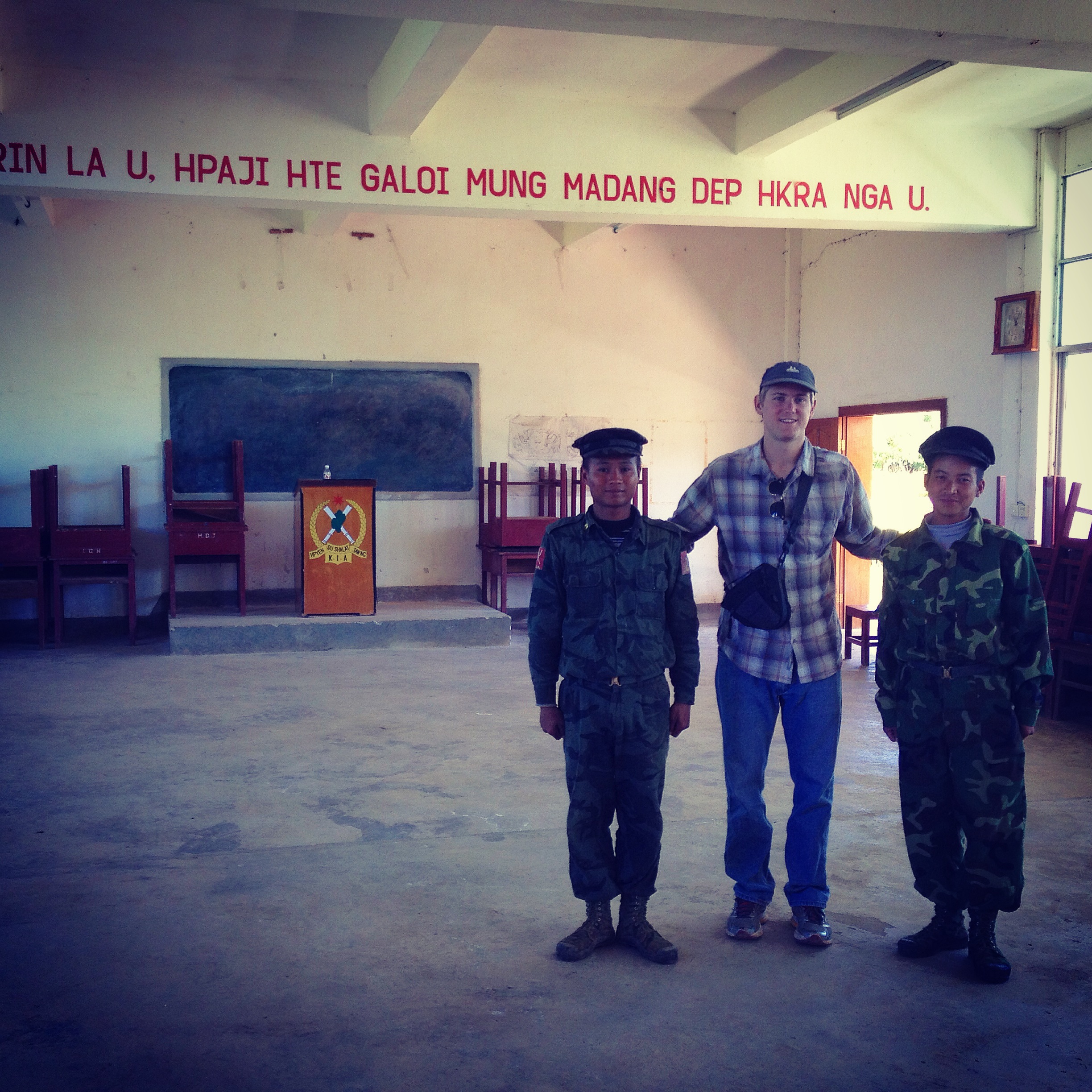
The author with rebel soldiers in Laiza, Kachin state in November, 2014.
I first started getting into photography while I studied abroad in southwest China in 2011. I had a Sony Cybershot HX9 point-and-shoot camera. With that I was able to get some really strong, high-resolution photos, arguably as good as any mid-range DSLR could do. A couple of years later I upgraded to a Nikon D5100 DSLR, which is my main piece today. There are differences.
As Lu-Hai said, the DSLR is less discreet. You have very little time when you arrive on a scene to snap truly candid photos before people notice that a photographer is in their midst. The point-and-shoot is not immune to this, but it’s easier to sneak by undetected with one than a DSLR, if that’s what you’re trying to do. Typically, I don’t worry about hiding my picture taking. If someone doesn’t want their photo taken they should be able to see me doing it and let me know themselves (and many people have).
Another point. It’s assumed DSLR photos are always going to be of a superior quality but this isn’t true. Point-and-shoot technology is really fantastic these days. Makers like Sony and Leica produce some superb point-and-shoots that can capture as good or better images than mid-range DSLRs. Really, what makes a DSLR better depends on the lens you have on it.
I was unimpressed with the stock lens that my D5100 came with so I bought a $140 Nikon 50mm prime lens from Best Buy. It was incapable of zoom or auto-focus but it took in a lot of light and produced some really high-resolution photos—when you got the focus right. Its limited frame, inability to zoom and manual focus made it a challenge but also a teacher. I learned to take care in each image and, while I lost a lot of potentially good photos to blurriness, that lens made me a better photographer.
It was the only lens I had on a recent jaunt through China and Burma and I got a bunch of photo essays published with it. I was able to capture images that I probably wouldn’t have thought of taking with my compact. It didn’t necessarily allow me to take better photos, but its limitations forced me to adopt a different perspective. In photography, that’s everything.
Brent Crane is a journalist with bylines in The Atlantic, Daily Telegraph, Aljazeera, Roads & Kingdoms, The Diplomat and VICE, among others. He can be found tweeting @bcamcrane.
His previous guest post is here.
DSLR vs Point-and-Shoot: a Journalist’s Consideration

My Canon Powershot S120, and Canon 450D DSLR; the photo was taken with my crummy mobile phone camera.
Lately I have been using my digital SLR. It’s a Canon 450D (also known as a Digital Rebel XTi). I’ve had my DSLR since 2008 but in the past two years I’ve neglected it, preferring to use my compact point-and-shoot: a Canon Powershot S120.
I dug out the DSLR as I wanted to walk around my neighborhood, shooting. It’s a very different experience. It’s the physical tangibility, that reassuring weight of a DSLR that is, I think, most influential in changing the approach you take to photography.
However, on journalism assignments and on freelance trips — to Burma, to North Korea — I have left behind the DSLR, and only brought my little camera. This is because the agility of the S120 and the ease of taking a usable photo with it is far quicker and more efficient than a DSLR.
Another thing I noticed when I was out and about with the DSLR was that the mere sight of it, the fact I was stopping and using this quite obviously noticeable camera changed my surroundings. People noticed me more, people actively tried to avoid the camera’s glare, and I, in turn, tried to be more conspicuous.
This is perhaps even more important.
If I used my DSLR in North Korea I would’ve taken fewer pictures and fewer photos of sensitive things, and the North Koreans would’ve been more sensitive to my presence. People have an almost instinctive reaction to a big, professional-looking camera far more than they do to a little compact.
Also, the quality produced by my point-and-shoot compared to the photos coming out of the DSLR are not massively different. With a DSLR, you can see more clarity, more cinematic colours, more depth of field, things that contribute to a more “3D” effect in the photo. But looking at photos taken with my S120 on the internet, you barely register the “inferiority”. For evidence see the photo galleries, which I took with the point-and-shoot, here and here.
I’ve sold photos using the S120 and the value of those images are in the fact they tell a story. The camera was inconsequential.
Sometimes I do feel wistful when I see fellow freelancers scoring photo galleries that I know would be difficult to manage with a compact camera. My friend Brent Crane’s photo story for Condé Nast Traveler is a case in point. The 12-picture gallery — ‘China to Pakistan: Road Tripping Across the World’s Highest Border’ — was shot on Brent’s DSLR and the vibrancy and sweep of the landscape shots are quite detailed in the way only the larger sensors found in DSLRs are capable of.
But I still trust in my little Canon compact to deliver the goods and I don’t foresee myself replacing it with a DSLR on journalism assignments.
I’m still broke — May 18th (life of a freelance journalist abroad)
It has been over a month since I quit my regular script-editing job at the TV company. And since then I have only been surviving on my freelancing income.
Since I came back from my Burma trip, which cost too much due to a mishap with flights, I have been more or less broke — having had to ask for an extension on paying my rent, and for a personal loan to bail myself out.
I have had two job interviews. One of these jobs would’ve been perfect; offering a flexible schedule and a great salary. I did not get it however. The other job is for a big news agency where competition is tough so I am unsure about my prospects.
I had a lot of stop and starts when I first came out here – gigs that fell through, pitches that were lame, a bank account that was at zero so many times I nearly packed it in and went back home (on multiple occasions). — Kate Hodal, freelancer turned Southeast Asia correspondent
When I read these words from Kate Hodal, I always feel better knowing that those before me, and also my peers, have struggled financially doing journalism.
But equally, when I see freelancers who are for more prolific than I am I feel spurred on to work harder and to find my own spread of amenable publications.
This is not to say I haven’t been enjoying myself — enjoying the acres of free time, partying with friends. That’s the beauty of China, money goes further: the experience of being broke here is unlike being broke in England, where relative poverty reduces choices more starkly.
But I thank the lord for my bank account’s overdraft.
I just remembered travel journalism

Writing about traveling is a lot of people’s dream job, combining the joy of expressing the experience of travel and getting paid to do it — it’s occupational paradise (I guess).
I’ve only done one piece of pure travel journalism in my career. A long time ago now.
But I haven’t pitched travel article ideas since I’ve been freelancing from my base in Beijing. Why not? I don’t really know.
Travel journalism is incredibly competitive, and it’s a shrinking industry. With bloggers, vloggers, and hundreds of tips, listicles and guidebooks out there it’s a saturated market.
However the market for unique travel stories, as well as the more literary travel narrative still exists.
I’ve been re-reading a travel book recently, one which I highly recommend. (I bought the book years ago but have been delving into it again as I want to write a travel narrative and want to glean clues about structure and detail).
Rolf Potts’ collection of travel stories ‘Marco Polo Didn’t Go There: Stories and Revelations from One Decade as a Postmodern Travel Writer’ is both one of the best travel story reading experiences and one of the best travel writing manuals.
The reason why the book also serves as a guide for travel writers is because of the ingenious decision to add a postscript to each story in the book. These postscripts fill you in on the details of the process of writing the travel story; why the author left some details out, and how the narrative came together; little asides on certain experiences; and thoughts on travel itself and modern tourism. The details contained in the postscript are gold-dust and worth more than reading a dozen Q&As with travel writers, simply because the postscript is closely paired to the travel story, so you can gain a kind of skeleton key into how a travel story is formed.
One of the standout stories in the book is about when Potts decided to try to invade the set of The Beach; the 2000 film set in Thailand starring Leo Dicaprio. His attempt is zany and born of a simple desire for adventure.
Adventure…I really should try to do more travel writing.


 Lu-Hai Liang