Archive for the ‘Features’ Category
Freelancing in Beijing: One Year On
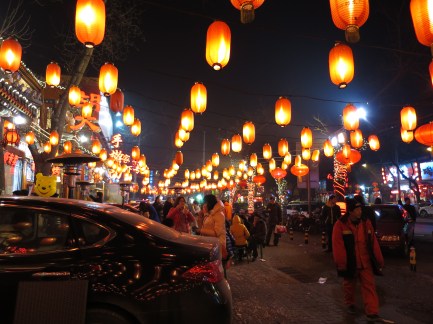
So I’ve been in Beijing for a year. Okay, it’s a little longer than a year: I arrived in Beijing 11th October, 2013.
Next month, I’m heading home (Hastings, England) for Christmas. I’ll be there for almost a month. It’ll be good to detoxify in England for a little while. Beijing is full of pollution…
So I’ve been here for over a year. What has happened? Originally, as I wrote in my first post while back in the city, I wanted to improve my Chinese to near-fluency (failed that one); get a decent paying job (that happened but may change in the very near future); travel more, write more.
I did travel more. But I did not write as much as I wanted to or should have done. That was the failure of this year. Second to that was not actively learning Chinese.
I made a group of friends. I lost a few who drifted away. I moved through a relationship (the loveliest I’ve had). I went up in the world by moving in to a nicer apartment. I gained some great new bylines. I lost freelancing momentum. I lost some enthusiasm. I regained some bad habits. I’ve felt professionally and personally stagnant. And I look to the future with the brightest ambitions but tempered with anxiety and doubt.
I cannot see the future. I think I know where I want to go, but the path to it is so unclear. I am 25. Young to those who’ve already experienced it, older to those still beating a fresh path. It does seem a little like a crossroads, although this could be just “end of the year” talk.
But the optimism remains.
How to summarize a year? I freelanced for Aljazeera, selling the pitch after the reporting trip which was risky but it worked out. I had CNN cancel a story on me but I managed to publish it elsewhere (unpaid but it got me in with some new editors). I wrote more and more for a section of a UK newspaper whose pay rates went up midway through the year.
I wrote for a video games publication I respect and it gladdened me as I want to break into games writing. I had a few commissions not contingent on my being in Asia which demonstrates how location can be irrelevant to freelance.
Money
I made £1634.35 from freelancing since I arrived in Beijing last October.
This money definitely helped the UK bank balance but clearly I’m not actually making bank from this. It supplemented the far healthier income I got from the Chinese TV job which meant I survived comfortably (although it often did not feel like it), with it financing an expensive reporting trip, visa runs to Hong Kong and two vacations.
But there have been short periods I’ve had to scrimp, and early next year I can foresee cash flow problems. I am not getting rich whatsoever. I am still surviving.
The freelance income probably merits further discussion. Certainly if I didn’t have the TV job I would have had to be much more prolific freelancing. The amount I earned, over a year, is not much at all. But it was good to have these semi-regular injections of cash which I plundered every so often to buy plane tickets. Certainly I’m going to have to step up the production rate if I’m going to be able to afford the kind of travel I wish to do next year.
Success: or lack thereof?
Like I’ve written before, the feeling of progression for a freelancer is not so obvious. We don’t go from Associate Freelancer to Deputy Freelancer to Freelancer-in-Chief. But the failures of the past several months I attribute to not chasing the stories hard enough, to not working in pursuit of the big stories, of the interesting people and things that are happening. I realize these failures and I hope that they’re instructive for what I need to change for 2015.
Life
Because moving to another country, settling in to a new city, isn’t just about bylines and becoming “successful”. There’s so much not said, so much that’s a part of living, especially in your 20s, struggling to understand what it is you’re supposed to be struggling toward. An account merely focused on the journalism and not the journey misses the daily textural quality of life, and the results of which you had never determined would be the destination.
To put it plainly, this blog captures some of that struggle. But of course it misses the thousand small things that you learn, that you understand and helps to expand a sense of what is possible and what is knowable when you are placed in a situation foreign to you.
Struggling to understand what it is you’re supposed to be struggling toward
I mentioned before I was in a relationship. The truth is, it was quite short in duration (although I visited her in Thailand, and we kept in touch). But the intensity of it made it feel that much longer and deeper. And that’s the important thing. The memory of it, the intensity. It doesn’t matter that some experience may be short-lived, because all that you’ll remember of it is that fleeting moment, and what you experience, from one moment to the next, are simply moments. Bubbles in time.
That is why I place great importance on the adventure of moving abroad, or simply to invite new challenges. My life in Beijing has its very great share of downs. But the ups don’t necessarily ameliorate the downs. Because that’s not the point. It’s not even about being “happy”. It’s about how much I’ve put myself through. About finding great contentment in the fact I’ve made a go at this crazy life in Beijing. And have, more or less, made it. I feel great pride in that. Because it’s an achievement purely for myself.
Links:
7 Things That Make Up Life in Beijing: A Photo Gallery
The phone
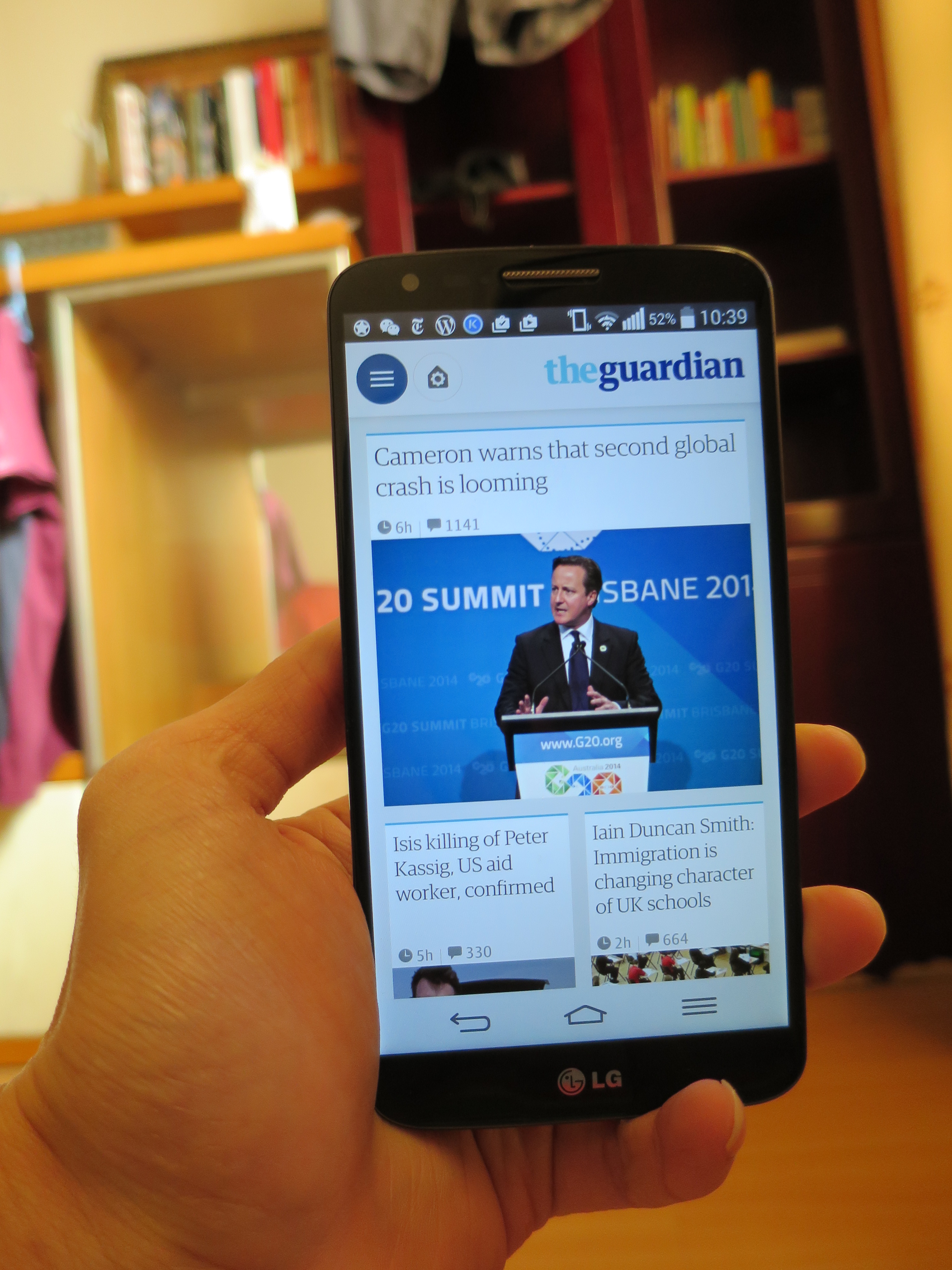
It’s the last thing I see at night and the first thing I wake up to. I can often be found reading stories from The Guardian’s mobile app.
5 Most Frequently Asked Questions about Being a Freelance Journalist in China
Since I’ve been blogging sometimes readers will take the time to email me with some questions. Here are the five most common ones I receive, and my answers to them:
1. How do you get a visa as a freelancer in China?
This is usually the most pressing question. And my guess is that this is the biggest hurdle for those thinking of coming to China to do journalism. The official J-visa (full visa status and accreditation as a professional journalist allowed to do journalism in China) is difficult to get. It’s not easy to get even with the full backing of a major news organization. Suffice to say that unless you are employed or sponsored by one of these large media companies, it will be nigh on impossible to secure a J-visa.
Part three: How to Make a Name for Yourself – As a Journalist

This is a continuing series exploring the strategies of success of journalists and writers. Parts one and two in the series can be found here and here.
Christopher Nolan is a film director with great power in Hollywood. He’s known for producing blockbuster movies – like his Dark Knight Batman trilogy – under budget and before deadline. Recently I read a brilliant profile of the British filmmaker written by Tom Shone; it’s an excellently reported piece.
What makes the article special is its description of Nolan’s commitment to his craft, emphasizing his abilities of focus to art and craft.
*
Cal Newport’s blog focuses on how people achieve success by continually bettering their skills. It’s a must-read blog for me. One of his mantras, culled from comedian Steve Martin’s memoir, is: “Be so good they can’t ignore you”. Newport emphasizes that to be not just good, but truly great, to rise to the top where the best get unduly rewarded, you have to focus not just on improving your skills – a given – but to concentrate your efforts on projects that will generate massive returns.
Needless to say, this can be quite difficult.
Part two: 4 Good & Bad Things about Living in Beijing
The Good: Cheap Accommodation. Accommodation in Beijing is not as cheap as you may think. It is, after all, the capital of China and increasingly overpopulated. But good deals can still be had. For example, I lived in a place that cost me RMB 3600 for three months (£120 per month). In China, you often pay for three months at a time. My apartment now, which is about seven times bigger than my previous place – and a whole lot nicer – is RMB 7500 for three months. Some of my friends pay more than this, but they get pretty decent bang for their buck: free internet, large living rooms, a cleaning service etc. The Bad: Poor Accommodation. So things may be somewhat cheaper but this can also mean things don’t work properly; tiny kitchens and nasty bathrooms. My current apartment has a king size bed that is almost collapsing, curtain rails that are held up by glue (which fell down) and a toilet that doesn’t refresh its flush reliably. The worst thing is probably the dirty and incredibly small kitchen which I would use more often if it weren’t so. But Beijing is full of old, poorly constructed housing, and new housing with poor attention to detail, so these are compromises you will be forced to make.

Beijing’s subway can be crowded
The Good: The Subway. It’s cheap, fast and reliable. It costs RMB 2 for all journeys. There are a surfeit of lines and it’s a convenient way to organize meet-ups. The Bad: The Subway. Commuting on the subway is horrible. It’s hot, sweaty and there are far too many people crammed in. Queues are disorderly and ill-mannered, and people still haven’t grasped the concept of first off, then get on. And services finish too early: by around 11.30pm (some lines close earlier than others).
The Good: The People You Meet. In Beijing, I’ve made Japanese, German, Italian, American friends. I’ve met people from Iran, Georgia, Azerbaijan and Nigeria. It’s easy to befriend such people because you’re all foreigners in a foreign land; it’s a common bind that makes striking up conversation easier. The Bad: The Smallness of Circles. Work friends and people you may see regularly for whatever reason become your friends in China. This limitation means your friendship circle can be suffocatingly small. From what I’ve observed your best bet is to make three close friends who are all mutual friends too; a strong base from which to branch out.
The Good: Great Opportunities. The opportunities that are afforded to you, especially in media, business, marketing, architecture, technology and fashion (to name just a few), in China are legion. People move up rungs of the ladder far faster here and your foreign status accords you instant prestige. In practice, this means that simply because you own a foreign passport, you are paid a salary far higher than your Chinese nationality co-workers (even if you work less than they do). It is not fair and although it is more competitive than it was five, ten years ago, such is the relative dearth of foreigners in China that demand still outstrips supply. The Bad: The Sense of Entitlement and White Face Worship. This treatment of foreigners means many a foreigner in China develops an inflated ego. I’ve met plenty of people who expect others to take an interest in them, rather than reciprocate and those who demand higher salaries for no apparent reason than the fact it’s simply not what they’d expect from back home. Those who are foreign will face some harassment, but those who are non-white will face discrimination they might not expect. For example, those with Asian faces may expect a few clubs demanding entrance pay while their white friends walk in for free.
Part One is available here.
Photography & The Journalist
It’s important to have interests. Passions. Things that delight and move you. It’s also important to consider the importance of imagery and style, elements that may inspire you in ways that you don’t quite understand.
When I see a good photo, a photo that manages to convey a feeling, an ineffable sense of grandeur – it somehow manages to inspire feelings of creative momentum.
Recently, I was put onto the work of Chinese photographer Wang Fuchun.

It’s a beautiful image. And shows the deftness with which Fucun manages to evoke the transient power of a moment, beautifully captured.
Here’s some more. Read the rest of this entry »
October 5th, Beijing
It is a Sunday afternoon in Beijing, in the middle of Golden Week, a national holiday here in China. The weather is cooling down, days are mild but the nights are drawing in. Autumn is the most beautiful season in Beijing, but the briefest, casting its warm glow before the harsh, bare winter.
Lately, I have found writing and pitching somewhat difficult. Freelance has been slow, very slow. I had been pitching but I found no reply from editors who have previously commissioned me. This is the worst; worse than rejection, it is the anxiety of not knowing that enervates the soul of a freelancer.
More than that, motivation is weak right now. And I am not sure exactly why. Maybe it is homesickness, maybe it’s a slight boredom with the whole affair of freelance journalism. Writing requires energy and I’ve found that energy to be depleted. The ambition is still there, but the actions required to reach it seem harder to take.
Life seems to get in the way too. Unlike before, I realize how important it is to just enjoy the moments that accompany a day and to look forward to those times where you can wallow in the luxury of doing things that you want to do. Hanging out with friends in Beijing, eating and drinking, playing poker, getting wasted in clubs is fun, sure. But it means the important work gets left behind. But that’s okay. But equally, it is absolutely no excuse whatsoever.
Of course, there needs to be balance. I find solace in the fact that this blog is going from strength to strength. But the desire to read all the articles I should be reading, to pitch editors, new and old, to send out emails, to sit down and plot out the essays and articles I know I’m capable of writing, is diminished. It worries me because the feeling is deeper and longer lasting that what I’ve felt before. But it doesn’t unnerve me. Writing is what I love to do the most.
I am also trying to get started on a book proposal This gives me something to be excited about, even if book publishing can be a long and arduous process. Book writing is what I’d really like to do. And although I love journalism, I know that literature will always win out. Journalism can be literature of course — it’s literary nonfiction that really compels me to be a better writer. Perhaps this is time out towards that end.

Is It Worth Doing Journalism Work Experience?
For my degree in multimedia journalism, I was required to do during the duration of my course a minimum of 4 weeks of work experience. My first ever bout of journalism work experience came earlier though, when I was 17 and still at college doing my A-levels.
At the time I was unsure of what I should do at university – I was good at English and good at writing. Although creative writing interested, I knew deep down that I was incapable of fiction and journalism took on more appeal.

At The Guardian offices, on work experience, September, 2012.
So I asked a staff member at college to help me arrange work experience with my local newspaper, The Hastings Observer. I spent a week at the newspaper and managed to gain three bylines. Two lessons stick out from that week: 1. That you could source a story from the Yellow Pages (remember those?) – a lesson not that useful now but opened up my awareness of how stories and sources can be located & 2. How powerful use of language can be and how even a slight variation in word choice can influence readers.
After that week ended I grew more attached to journalism and its raggedy, amateur art.
When it came time to select courses and universities, my stepfather and I went on a tour of the different journalism degrees. Some presentations were much better than others. Some were downright off-putting. It came down to two choices: City University in London and Bournemouth University. At the time City Uni did not do only a journalism BA. It was History with Journalism. Bournemouth Uni appealed as it taught multimedia journalism which was NCTJ approved and because it was by the sea.
Anyway, I deferred for a year, taking a gap year which eventually turned into two. I started my course at age 20.
A list of media work experience/internships that I did from 2009-2012:
- The Brighton Argus
- Splash News
- The Press Association
- Catch22
- The Guardian
- The Beijinger
The Press Association (video department) was a great experience as I got the opportunity to interview Boris Johnson (mayor of London) and MPs, participate in a press scrum and attend a beer festival. The UK’s national news agency has a great scheme that if I had pushed more, perhaps I could have got on to, but it would have required a three year commitment or thereabouts.
The Guardian work experience was offered to me by the editor as I had written a couple of articles for her previously (unpaid) and so they gave me a week. It was a dream to enter The Guardian’s gleaming offices near King’s Cross, London and I saw a couple of journalists I’ve long admired.
It is very much worth doing work experience, but in my opinion it is not worth doing it overmuch. You can also get lucky. A few coursemates of mine got jobs from them, and one of them is now editor at a major publication. It can also be helpful to gain contacts as it can make it easier to pitch later on. An acquaintance here in Beijing occasionally writes for Esquire (UK) as he once interned for them.
It will really help your time on your internship if you can pitch story ideas. Do not be afraid to suggest ideas to your editor. It shows initiative, charm and power. Anyone who has a store of good ideas is a source of power for a creative outlet. You will be seen in a much better light if you have the confidence to pitch and the boldness to articulate them. You lose nothing. Even if your ideas are not accepted, do not lose hope, it only takes one to strike for you to be given an opportunity.
It helps if the staff like you too. I have found in my experience that if the staff take a shine to you, they will overlook any deficiencies or weaknesses you may have simply because they like having you around in the office. Do not underestimate how important this is. Having good social skills is a skill and intelligence in itself. And those who possess it have an equally legitimate skill as those good with numbers or a facility for study.
One Year Anniversary: theluhai.com
On September 22nd, 2013, I published this site’s first blog post. It set out the themes and aims; an introduction to a chronicle of my time spent trying to be a freelance correspondent. Since then the site has pulled in a steadily growing audience – last month hitting a milestone of over a thousand views.
Here is the first ever post: Welcome: mission statement
And here are the following two: What happened last time I tried to be a freelance foreign correspondent and 6 things I learnt about the freelance journalism market while I was in China.
Thanks to those who read and follow the blog. And big thanks to those who have taken the time to personally email me, and in a couple of cases, to even seek me out when they were in Beijing. It means an immeasurable amount.
Part two: what exactly is a freelance foreign correspondent?

Riding the Pyongyang Metro. Going to North Korea has so far been my only instance of travel + journalism. I aim to remedy this.
So far this year I have traveled to Thailand twice, but entirely not for journalism reasons. But I have also traveled to North Korea and this was for journalism. I filed two stories and a photo gallery. But they were features. I did not seek out war zones or conflict areas, natural disasters or political turmoil. I did not attend any riots or charter a plane to any typhoon-hit areas. When news happens, foreign correspondents will scramble and make a dash to the area affected.
Later this year I am planning to go to Myanmar. It seems a fascinating country (the second largest in southeast Asia) on the cusp of so many developments. I want to go and explore, seek out stories and get to know the place better. I had been developing a Myanmar story for months now, checking up on it, cultivating a source, and a major newspaper was interested in the story. But then someone beat me to the punch with a similar but not-quite-the-same story and the newspaper declined, so now I will attempt to sell it elsewhere.
There’re a lot of unknowns so I feel like I have to go there to get a better nose for the angles that might sell, that might interest editors who don’t really care. They worry not about how interesting something is, but how relevant and resonant a story might be.
I should do a lot of background reading (and video watching) to get a better sense of the country, arrange to go there, talk to as many people as I can find while there, and travel around inside. It might take a month or so. I cannot simply parachute in and expect to write things.
Should a freelance foreign correspondent be expected to dig into time and funds in pursuit of stories while living awhile somewhere new?
I don’t know. I only know what I want to do. And that’s to go to Myanmar. To see what it’s like, find stories and write them. But I will have to try to ensure the best chance possible of being published and being paid. Travel without publication and payment for a traveling journalist is not sustainable and an untenable luxury.
For part one in this series go here. A post on travel + journalism is here.


 Lu-Hai Liang